


Donner and Blitzen: Loyalty, Instinct, and Trust

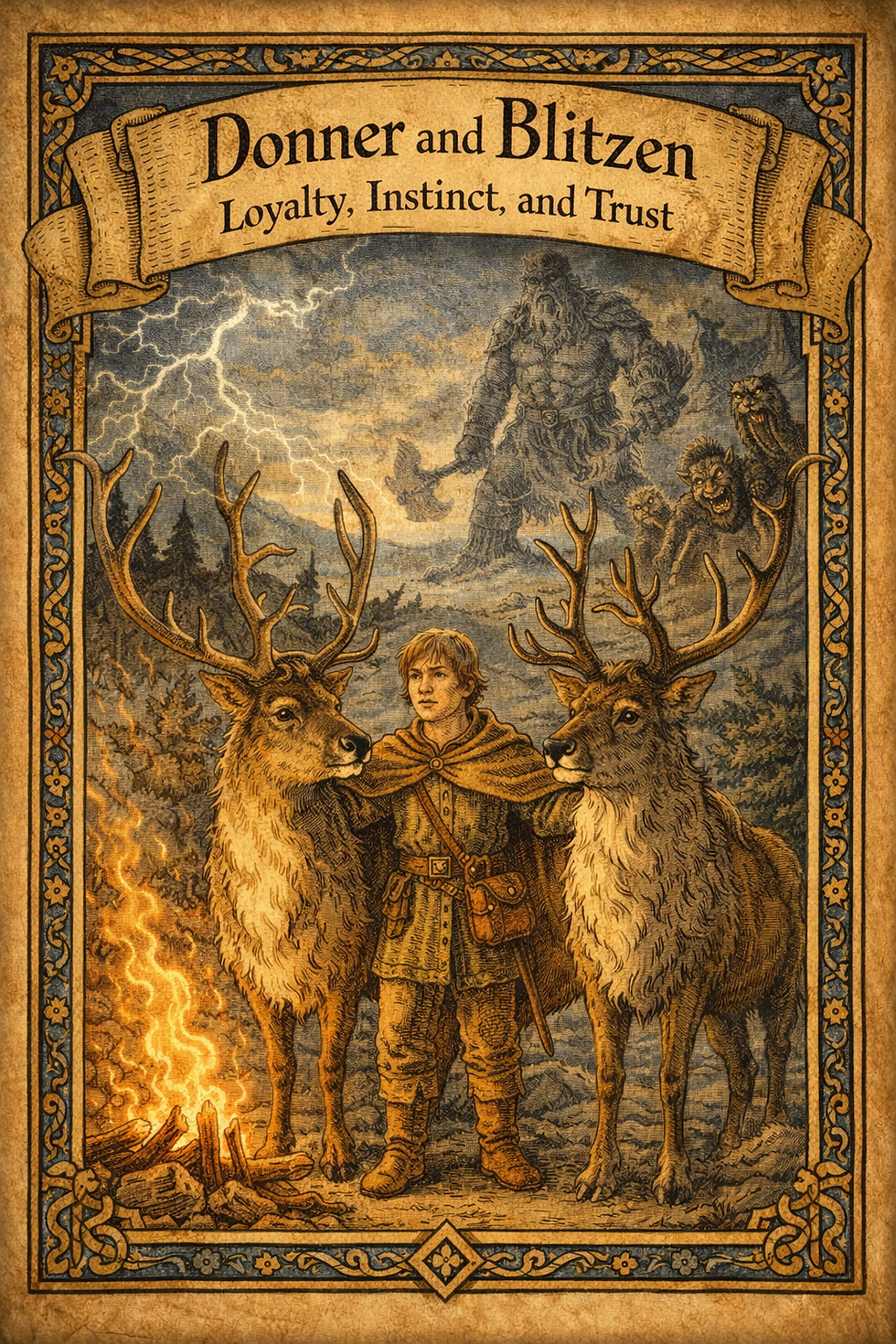
In the old forests where snow settles like whispered secrets upon the pine boughs, there are tales not merely told for entertainment, but for formation. Among these tales stand two noble creatures whose hooves thunder like drums of destiny and whose hearts shine brighter than winter stars: Donner and Blitzen, the twin reindeer companions of young Ulvie.
Their names, meaning Thunder and Lightning, were not given lightly. Born in the midst of a roaring storm, when the heavens split with light and the earth trembled beneath the sky’s voice, the twins entered the world already marked by wonder.
It was Ulvie and the gnome Valknickel who first discovered them, shivering yet fierce, as if the storm itself had taken shape in living form. From that moment forward, their fates were bound together, not by rope nor rein, but by loyalty, instinct, and trust.
Loyalty Forged in the Wild
Children understand loyalty instinctively, though they may not yet have the words for it. They see it in animals, in friends, and in stories long before they analyze it. Donner and Blitzen embody this virtue in its purest form. They do not serve Ulvie because they must; they stay because they choose to.
Whether facing the ruthless poachers who stalked the forest shadows or standing firm against the monstrous hog Hrungnir, the twins never fled. Danger did not scatter them. Fear did not weaken them. They planted their hooves beside Ulvie and remained.
This kind of loyalty teaches children a truth deeper than instruction: real friendship is proven not when skies are clear, but when storms gather. In a world where companionship is often portrayed as convenient or conditional, characters like Donner and Blitzen remind young readers that true friends stay, especially when leaving would be easier.
Instinct Guided by Love
Animals in folklore often symbolize instincts uncorrupted by pride or selfishness. Donner and Blitzen possess keen senses sharpened by forest life: they hear what others cannot, sense danger before it appears, and move with the silent wisdom of wild creatures. Yet their instincts do not lead them away from peril; they lead them toward Ulvie.
This is a powerful lesson for children. Instinct is not merely survival; it can be devotion. The twins’ natural awareness does not make them cautious cowards; it makes them courageous guardians. They know the risks. They feel the tremor of approaching giants, the scent of trolls in the wind, the tremble of the earth beneath approaching foes. And still, they stay.
Their instincts are guided by love rather than fear.
For a child, this is a profound image: bravery is not the absence of fear, but the decision that someone else is worth facing fear for.
Trust Stronger Than Iron
Trust is fragile in the modern world. It is often portrayed as something easily broken, rarely restored. But in the old storytelling tradition, the kind that shaped legends and carried wisdom across generations, trust is sacred.
Donner and Blitzen trust Ulvie completely. They trust his voice when he calls them from afar. They trust his hand when he calms them in battle. They trust his judgment even when the path ahead is shadowed and uncertain.
And Ulvie trusts them in return.
He trusts their speed when escape is needed. He trusts their strength when foes approach. He trusts their hearts when hope grows thin.
This mutual trust transforms them from companions into brothers.
Children reading such stories absorb this truth without realizing it: trust is not given lightly, but once given faithfully, it becomes stronger than iron chains or fortress walls.
Courage That Inspires
Courage is often misunderstood. Many imagine it as loud heroics or fearless charges into battle. Yet Donner and Blitzen show another kind of courage, the steady courage of presence.
They do not boast. They do not seek glory. They simply stand.
Against trolls.
Against giants.
Against hunters.
Against darkness.
And when the day came that they learned to fly, when their hooves left the earth and the wind welcomed them as kin, their courage did not change. They did not become proud. They did not abandon the forest or forget their friend. Instead, they became something greater: protectors not bound by ground or sky.
For children, this transformation is more than magical spectacle. It is symbolic truth. Growth should never erase humility. Strength should never destroy kindness. Power should never replace loyalty.
The Greatest Love
Perhaps the most moving truth embodied by the twin reindeer is found in the ancient biblical principle:
“No greater love than this, that one lay down his life for a friend.”
Again and again, Donner and Blitzen prove they would do exactly that.
They step between Ulvie and danger without hesitation. They charge foes larger than themselves. They risk injury, capture, even death.
Not because they are commanded. Because they love him. We see the same echoed in the Gospels, Christ’s faithfulness toward us.
This message resonates deeply with young readers. In a culture that often celebrates self-preservation above sacrifice, stories like these remind children that the highest form of love is selfless devotion. It teaches them that heroism is not measured by power, but by willingness to protect others.
More Than Friends, Brothers
There is a difference between friendship and brotherhood. Friendship is chosen companionship. Brotherhood is chosen belonging.
Donner and Blitzen are not merely companions who accompany Ulvie on adventures. They are part of his very life. Where he goes, one of them is always near. Where danger rises, they stand beside him. Where sorrow falls, they remain until it lifts.
Children long for this kind of bond, even if they cannot articulate it. They desire relationships that are steady, faithful, and unbreakable. By witnessing such devotion in story form, they learn what such relationships look like, and, more importantly, how to become that kind of friend themselves.
Why Characters Like Donner and Blitzen Matter
Folklore-rooted characters endure because they teach without preaching. They shape hearts quietly. They cultivate virtue through wonder.
Donner and Blitzen do not lecture about loyalty. They live it. They do not speak sermons about courage. They demonstrate it. They do not explain trust. They embody it.
This is why such characters are invaluable for children’s literature. Lessons learned through story sink deeper than lessons spoken aloud. A child who watches a character act bravely begins to imagine acting bravely. A child who sees loyalty honored begins to value loyalty. A child who witnesses sacrificial love begins to understand its beauty.
The Unstoppable Trio
When the twins finally learn to fly, their unity with Ulvie becomes legendary. Together they form a trio not unstoppable because they are invincible, but because they are united.
Unity is their true strength.
One heart.
One purpose.
One bond.
This teaches perhaps the greatest lesson of all: strength multiplies when it is shared. A single hero may accomplish much, but companions bound by trust can accomplish the impossible.
Conclusion: Thunder, Lightning, and the Heart of Story
Donner and Blitzen are more than enchanted reindeer. They are living symbols of truths children need: loyalty that does not waver, instinct guided by love, trust that endures, courage that stands firm, and friendship that becomes brotherhood.
Their thunder is not merely sound. Their lightning is not merely light. They are the storm that drives fear away.
And beside them stands Ulvie, not alone, never alone, because true friends do not vanish when shadows lengthen. They draw nearer.
In a world that often moves too quickly and values too little, stories like these slow the heart and steady the soul. They remind children, and adults, that the greatest heroes are not always kings or warriors.
Sometimes they are two faithful companions who refuse to leave a friend’s side.
Until next time, keep your fires lit.
Timothy Paul Spradlin


Comments